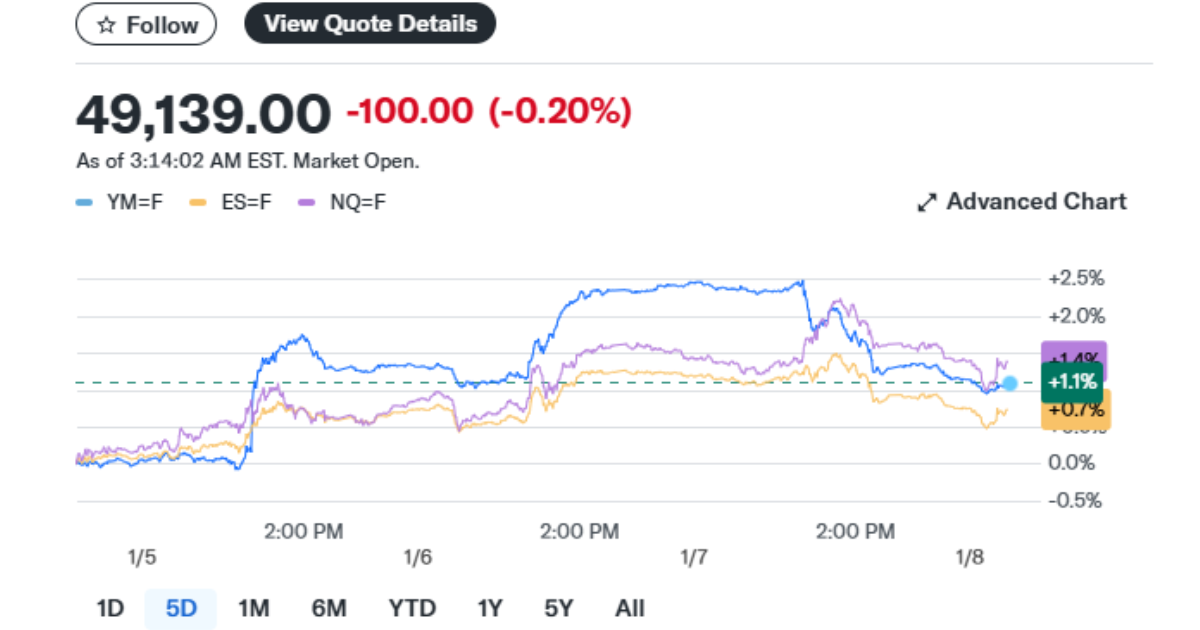
U.S. stock futures moved lower as Wall Street paused after a strong start to 2026. Futures tracking the Dow Jones Industrial Average, S&P 500, and Nasdaq 100 slipped, signaling growing caution among investors who had fueled the early-year rally.
After weeks of steady gains, markets are showing signs of consolidation. This shift reflects a familiar pattern: when stocks climb quickly, investors tend to reassess risk, lock in profits, and wait for fresh catalysts before making their next move.
According to Yahoo Finance, U.S. stock futures dipped after major indexes struggled to hold intraday highs in the previous session, despite strong participation earlier in the day.
Credit: Yahoo Finance
Why the Market Rally Is Cooling Off
January’s rally was driven by optimism around cooling inflation, resilient corporate earnings, and continued enthusiasm for artificial intelligence. However, as valuations stretched, traders became more selective.
The Dow Jones and S&P 500 closed slightly lower in the prior session, while the Nasdaq Composite saw limited upside supported by select technology stocks. This divergence highlights a market increasingly dependent on fundamentals rather than broad-based momentum.
Wall Street behavior and investor positioning are also explored in Wall Street’s strategy toward crypto investors, which explains how institutional players adjust risk exposure when markets heat up.
Tech Stocks Shine, But Can’t Carry the Whole Market
Technology stocks remained in focus, though gains were uneven. Alphabet (GOOGL) briefly overtook Apple (AAPL) in market capitalization, marking a notable shift driven by confidence in Alphabet’s AI investments and advertising strength.
While this milestone grabbed headlines, broader tech momentum failed to lift the entire market. Investors showed hesitation in chasing prices higher, particularly with key economic data ahead.
This behavior suggests that markets are transitioning from “buy everything” mode to a more disciplined, stock-by-stock approach — a healthy sign for long-term stability.
Key Factors Investors Are Watching Right Now
Several developments are shaping near-term market sentiment and influencing U.S. stock futures:
1. U.S. Economic Data
Investors are awaiting labor market data that could impact inflation expectations and interest rate outlooks. Employment strength or weakness often plays a critical role in shaping Federal Reserve policy assumptions.
2. Federal Reserve Policy Signals
Although no immediate rate change is expected, even subtle shifts in Fed communication can move markets, as investors closely track the Federal Reserve interest rate outlook to gauge how long borrowing costs may remain elevated.
3. Trade and Tariff Developments
Ongoing discussions around tariffs remain on the radar, as outlined in recent U.S. Securities and Exchange Commission disclosures, with potential changes impacting corporate margins, supply chains, and investor confidence—especially in globally exposed sectors.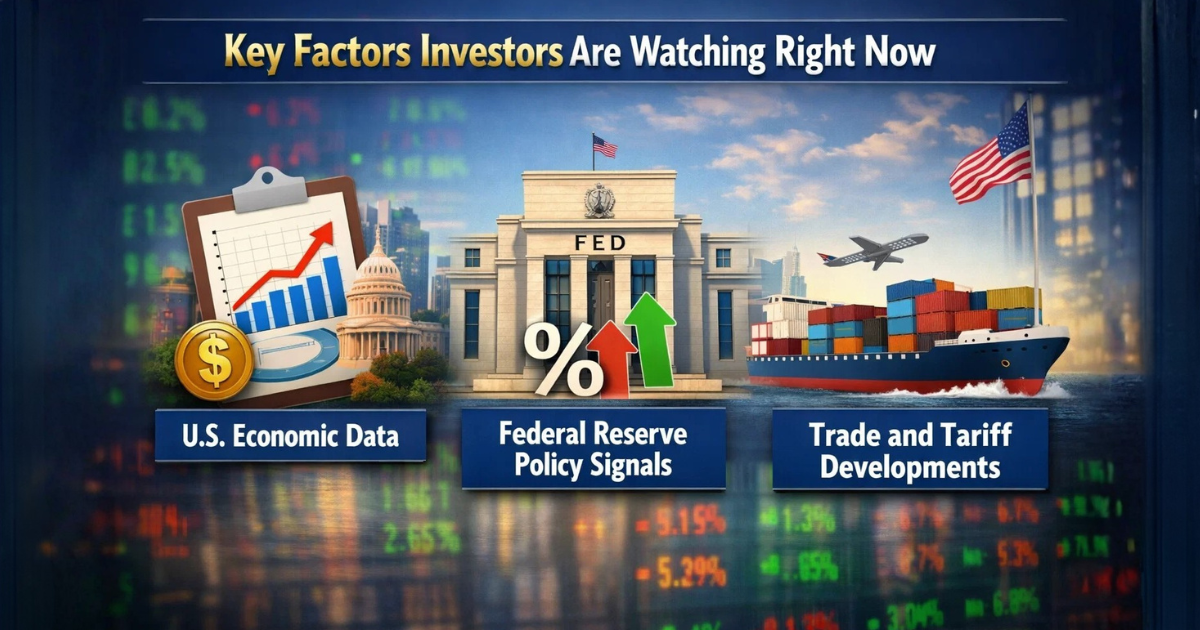
What This Means for Stock Investors
For long-term investors, the pullback in U.S. stock futures looks more like consolidation than a warning sign. There is no evidence of panic selling, liquidity stress, or systemic risk. Institutional investors continue to rebalance portfolios rather than exit the market altogether. This suggests confidence in the broader economic backdrop, even as short-term volatility increases.
For short-term traders, choppy conditions may persist until clearer signals emerge from economic data or policy developments. Risk management remains essential during these pauses in momentum. Watch live stock market updates including index trends and futures from CNBC‑TV18 relevant for U.S. stock futures analysis.
Global Markets Still Take Their Cue From Wall Street
Movements in Dow Jones futures and S&P 500 futures often set the tone for global trading sessions. Despite recent volatility, international markets remain closely tied to U.S. economic signals and earnings trends.
As long as inflation remains controlled and earnings stay resilient, many analysts view market dips as part of a normal cycle rather than the start of a downturn.

Markets Are Catching Their Breath—Not Tapping Out
The dip in U.S. stock futures shows that Wall Street isn’t panicking — it’s pausing. Investors are recalibrating after a strong early-2026 rally, focusing on fundamentals, earnings, and macroeconomic signals rather than short-term noise.
For disciplined investors, this is a reminder: volatility is normal, but U.S. stock futures remain a key tool to track market direction and opportunities. Stay focused, stay informed, and let fundamentals lead the way with Financecurves.
FAQs
What are U.S. stock futures?
U.S. stock futures are contracts that predict the future price of major indexes like the Dow, S&P 500, and Nasdaq. They help investors gauge market direction before the stock market opens.
Why are Dow, S&P 500, and Nasdaq futures falling today?
Futures fall when investors anticipate profit-taking, economic data, or policy developments that could affect markets. Today’s decline reflects caution after the early-2026 rally.
How do Federal Reserve interest rate outlooks affect stock futures?
Even minor Fed signals can influence borrowing costs and investor confidence. A tighter outlook may lead to weaker futures, while dovish guidance can lift market sentiment.
Can tech stocks like Alphabet and Apple influence broader market futures?
Yes, major tech companies can move indexes, especially Nasdaq. Strong earnings or AI growth can boost futures, while underperformance may drag the market lower.
How should investors respond to short-term dips in stock futures?
Long-term investors should focus on fundamentals and earnings rather than panic selling. Short-term traders may adjust positions, but diversification and risk management remain key.
Disclaimer
The information provided on this website is for informational and educational purposes only. While we strive to ensure accuracy and keep our content up to date, FinanceCurves makes no guarantees regarding the completeness, reliability, or accuracy of any information published.
Nothing on this site constitutes financial, tax, legal, or investment advice. Readers should consult a qualified financial advisor, certified tax professional, or licensed attorney before making any financial decisions. Your individual situation may vary, and decisions based on information from this website are made at your own risk.
FinanceCurves may reference government agencies, financial institutions, or official programs for informational purposes only. We are not affiliated with, endorsed by, or connected to any government entity, including the IRS or any federal or state agency. Some content may contain links to third-party websites for additional context or resources. We are not responsible for the content, accuracy, or practices of any external sites.
By using this website, you agree to this disclaimer and our terms of use.