
The DeFi Infrastructure Bet Most Retail Investors Overlook
Crypto markets reward narratives fast. They reward infrastructure slowly. That is where the ALBT coin price becomes interesting.
Unlike hype-driven tokens, ALBT sits behind a project aiming to bridge decentralized finance with regulated capital markets. That positioning sounds powerful. But positioning alone does not move price.
Adoption works. Liquidity exists. Execution is effective. So the real question isn’t whether AllianceBlock appears promising. It is whether the fundamentals justify exposure in 2026.
What Is ALBT and Why Does Its Positioning Matter?
ALBT is the native token of AllianceBlock, a blockchain infrastructure project focused on connecting traditional finance with DeFi systems.
Its core focus includes:
- Regulatory-aligned DeFi infrastructure
- Frameworks for tokenizing assets
- Cross-border solutions for capital markets
This isn’t a meme coin design. It is an infrastructure model.
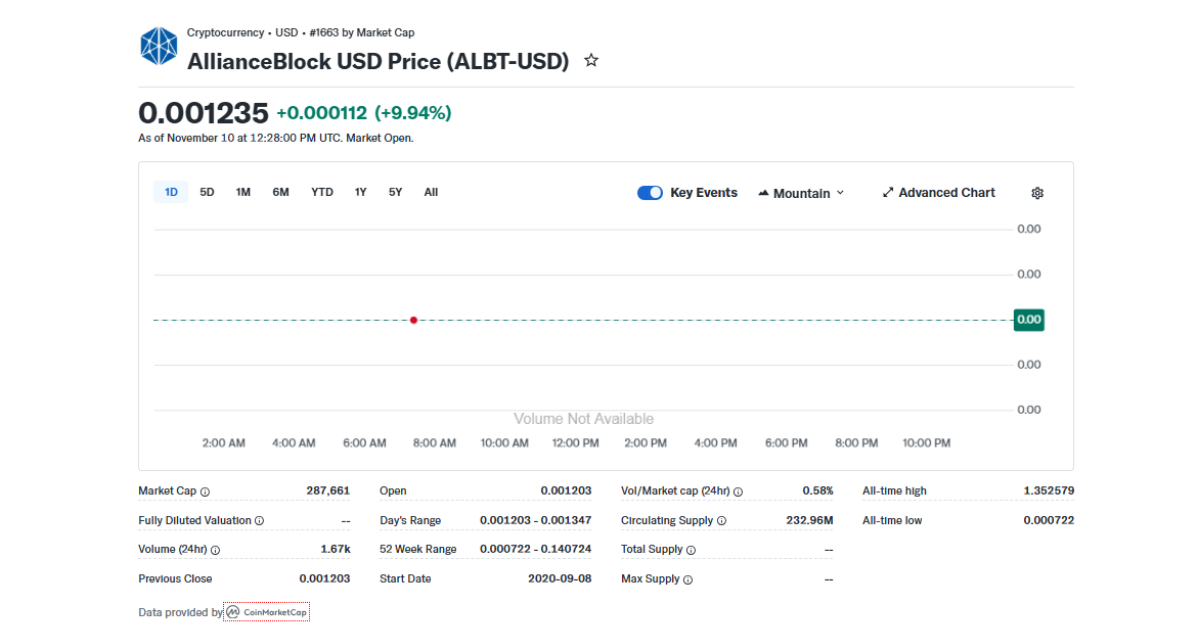
Infrastructure projects operate differently than speculative tokens. They rely on collaboration, integration, and measurable ecosystem growth. This slows price appreciation, but it may be more sustainable if execution succeeds. To monitor the latest real-time movement in ALBT price, check the current trading data on Yahoo Finance, which tracks ALBT against USD.
ALBT Coin Price Today: What the Market Is Really Saying
Tracking the ALBT coin price today provides information about market sentiment.
The current characteristics are:
- Market positioning for mid-cap companies
- Moderate liquidity compared to larger altcoins
- Daily volatility between 5% and 15%
- Strong correlation with broader altcoin cycles
Changes in liquidity have a significant impact on mid-cap tokens. Capital rises rapidly when it rotates into riskier assets. They fall more quickly than big caps when liquidity contracts. ALBT is consistent with that pattern. The mood of the market is reflected in short-term movement. Ecosystem traction is reflected in long-term movement.
Why ALBT Has Not Exploded Yet
Many investors ask why ALBT has not experienced a sustained breakout.
Three structural reasons explain this:
- Infrastructure needs implementation rather than just focus.
Speculation may cause short-term price increases, but real usage is what sustains long-term growth. - Liquidity depth continues to be limited.
Having a shallower order book depth can lead to higher volatility and discourage large institutional investments. - Regulatory positioning can be both beneficial and risky.
Compliance-focused projects thrive on clarity but face challenges when uncertainty arises.
Until adoption metrics visibly expand, price remains tethered to broader market momentum.
Historical ALBT Price Behavior: Classic Mid-Cap Volatility
ALBT has followed a familiar cycle:
- Strong upside during DeFi enthusiasm phases
- Sharp retracement during crypto-wide corrections
- Stabilization during consolidation periods
Mid-cap tokens rarely trend smoothly. They surge during liquidity expansions and compress when capital rotates toward safer assets.
This historical behavior suggests one important pattern: ALBT performs best when overall altcoin confidence returns.
ALBT vs NXRA: Which Has the Stronger Risk Profile?
When investors compare ALBT and NXRA, the conversation usually centers around one key question:
Which one offers better risk-adjusted returns?
Both projects operate in the DeFi infrastructure space. Both target real-world asset integration and regulatory-friendly blockchain solutions. But their market behavior tells slightly different stories.
Market Comparison Overview
| Factor | ALBT | NXRA |
| Market Cap | Smaller mid-cap | Larger mid-cap |
| Liquidity | Moderate | Higher |
| Volatility | Elevated | Moderate |
| Upside Potential | Higher | Slightly lower |
| Risk Profile | Higher | More balanced |
What This Means:
- ALBT: Higher upside in aggressive bull cycles, but elevated volatility.
- NXRA: Smoother capital exposure due to larger size and liquidity.
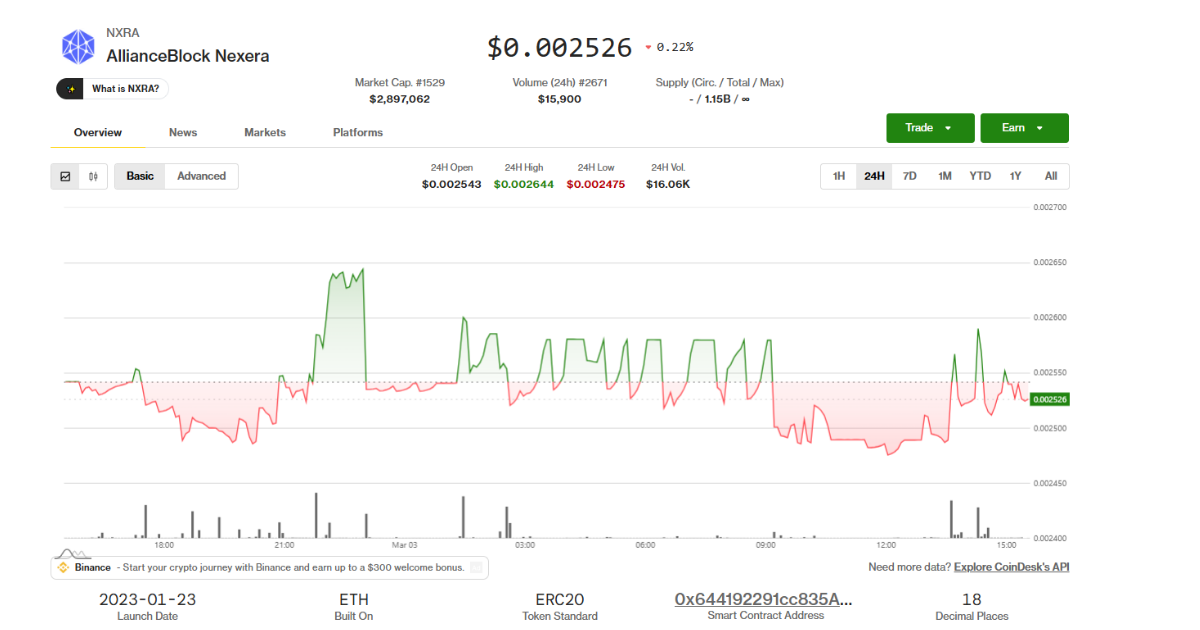
Neither asset is “safe.” Both are speculative and sensitive to market cycles. For up-to-date market performance and pricing metrics on NXRA, consult the detailed price page on CoinDesk, a leading crypto news and data platform.
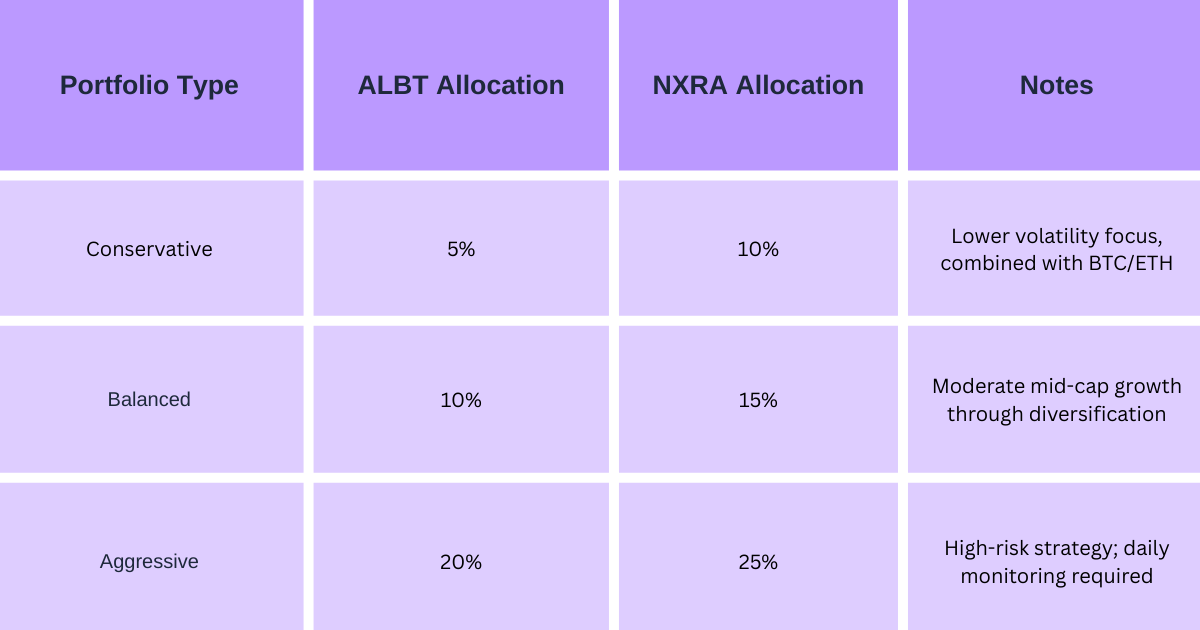
Suggested Portfolio Allocation Strategy
| Portfolio Type | ALBT Allocation | NXRA Allocation | Notes |
| Conservative | 5% | 10% | Lower volatility focus, combined with BTC/ETH |
| Balanced | 10% | 15% | Moderate mid-cap growth through diversification. |
| Aggressive | 20% | 25% | High-risk strategy; daily monitoring required. |
These allocations assume the remainder of the portfolio includes large-cap cryptocurrencies for stability.
Price Prediction 2026
Scenario-based forecasts consider market cycles, regulatory clarity, and adoption trends.
| Scenario | ALBT Price Range | NXRA Price Range |
| Bullish | $0.10–$0.12 | $0.40–$0.45 |
| Moderate | $0.05–$0.07 | $0.28–$0.32 |
| Bearish | $0.03–$0.04 | $0.20–$0.25 |
These ranges highlight realistic possibilities rather than hype-based targets. Smaller-cap tokens like ALBT can outperform during aggressive altcoin cycles but remain vulnerable during market corrections.
What Would Actually Need to Happen for ALBT to Double?
Forget generic bullish or bearish cases. Price appreciation requires real triggers:
Measurable Ecosystem Expansion: Actual increases in integrations, transaction activity, and capital flow.
Liquidity Growth: Deeper order books and broader exchange access attract larger investors.
Regulatory Clarity: AllianceBlock’s compliance positioning becomes a competitive advantage only if frameworks stabilize.
Markets reward traction, not potential.
Risk Exposure: The Hard Truth About Mid-Cap DeFi Tokens
Before buying ALBT, investors must evaluate:
- Regulatory uncertainty
- Liquidity concentration risk
- Smart contract exposure
- Market cycle dependency
- Competitive infrastructure alternatives
Mid-cap tokens amplify both gains and losses. That is their nature. No infrastructure token is immune to macro liquidity shifts. You can also review ALBT’s broader market data and price history on Crypto.com’s price tracker to gain additional context on historical trends.
Capital Efficiency: Is ALBT Worth the Allocation?
Instead of asking how much to allocate, ask:
Is ALBT delivering superior risk-adjusted return compared to alternatives?
Every dollar invested carries opportunity cost. Disciplined investors reassess exposure quarterly rather than emotionally. This mindset separates strategic positioning from speculative behavior.
What Could Drive Sustainable Growth?
Sustainable appreciation would likely require:
- Institutional partnerships with measurable scale
- Demonstrated real-world DeFi integration
- Expansion into jurisdictions with clear crypto regulations
- Increased developer activity within the ecosystem
Without measurable usage growth, price appreciation remains cycle-dependent.
The Reality Check Most Retail Investors Ignore
ALBT occupies a competitive and execution-sensitive segment of crypto.
- It lacks meme momentum.
- Large-cap insulation is absent.
- Delivery is a determining factor.
Because of this, it is both fragile and effective. ALBT can perform better during periods of high liquidity if AllianceBlock transforms positioning into quantifiable adoption. Stasis becomes the inevitable result if performance stalls. The market does not reward ambition. It rewards results.
For deeper crypto market breakdowns, real-time price insights, and disciplined investment analysis, follow Financecurves and stay ahead of the next market move.
Frequently Asked Questions
What is ALBT coin used for?
ALBT powers the AllianceBlock ecosystem and supports DeFi infrastructure applications.
Is ALBT a high-risk investment?
Yes. As a mid-cap token, it carries elevated volatility and liquidity risk.
What affects ALBT coin price the most?
Liquidity cycles, DeFi adoption metrics, regulatory developments, and overall altcoin sentiment.
How does NXRA differ from ALBT?
NXRA has higher liquidity and slightly lower volatility but operates in a similar infrastructure segment.
Can ALBT outperform large-cap cryptocurrencies?
Possible during aggressive altcoin cycles, but risk exposure is significantly higher.
Should beginners invest in ALBT?
Only with diversified portfolios and strict risk management.
Disclaimer
Cryptocurrency assets are highly volatile and involve substantial financial risk. Prices can fluctuate significantly within short periods. This article is for informational purposes only and does not constitute financial advice. Always conduct independent research and consult a licensed financial advisor before making investment decisions.

Charles Cooper is a Senior Cryptocurrency Analyst at FinanceCurves.com with over 10 years of experience in financial markets. He specializes in Bitcoin, digital assets, blockchain technology, and on-chain analysis, providing research-driven insights grounded in market data, macroeconomic trends, and risk management principles. Charles helps readers navigate volatility, adoption trends, and evolving regulatory and market dynamics in the cryptocurrency and broader financial landscape.