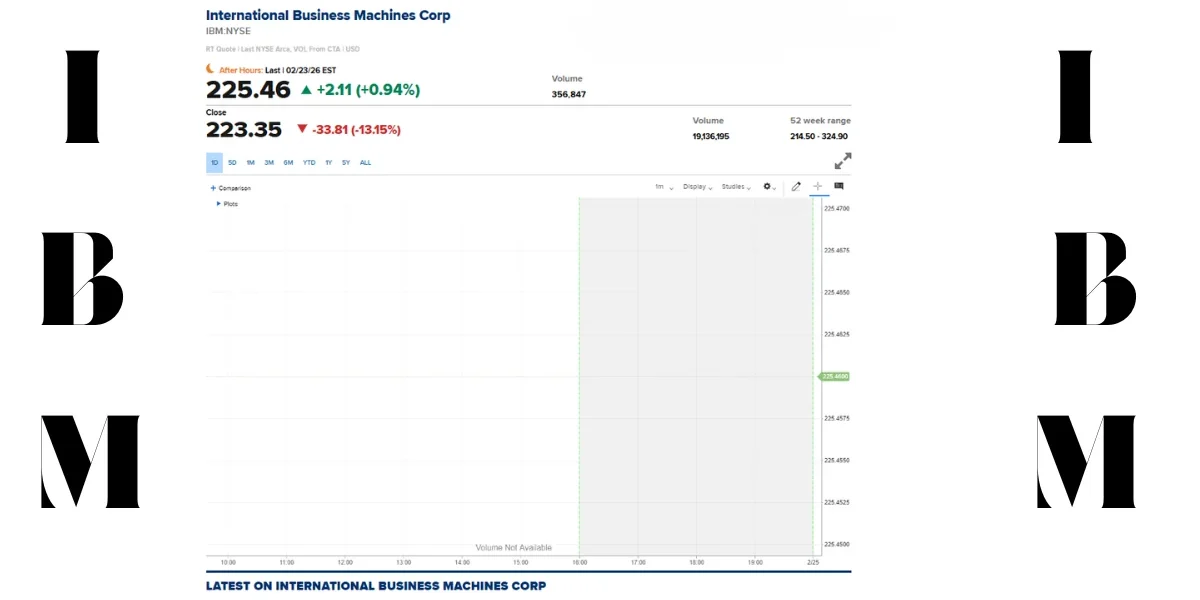
IBM stock is facing renewed selling pressure after fresh concerns emerged that artificial intelligence could erode one of the company’s most stable revenue streams: COBOL modernization and legacy infrastructure services.
According to a recent CNBC report, IBM shares declined sharply after comments suggesting that advanced AI systems, particularly those developed by Anthropic, may significantly reduce demand for human-led COBOL programming and modernization work.
For investors, this raises a deeper question: Is IBM’s legacy services moat at risk in the AI era?
Why IBM Stock Reacted So Strongly
IBM stock has long been viewed as a defensive technology play. With a market capitalization above $180 billion in early 2026, IBM has relied heavily on recurring enterprise contracts, infrastructure consulting, and modernization services.
One key component: maintaining and updating COBOL-based systems used by governments, banks, and insurance firms.
A sizable chunk of the world’s financial infrastructure is still operated using COBOL (Common Business-Oriented Language), which was created in 1959. Based on industry research and estimates referenced by Reuters:
- Globally, more than 200 billion lines of COBOL code are still in use.
- The COBOL system is used in 70–80% of face-to-face financial transactions.
- The use of COBOL-based platforms is still very prevalent among U.S. federal and state agencies.
IBM has built a steady modernization business, helping institutions migrate or maintain these systems. But AI models capable of reading, translating, and refactoring legacy code could disrupt that revenue stream.
When investors realized AI tools may automate portions of this work, IBM’s stock sold off.
The AI-Cobol Threat: What Anthropic’s Breakthrough Signals
Anthropic’s latest AI systems reportedly demonstrate strong capabilities in understanding and converting legacy programming languages, including COBOL, into modern codebases.
If AI tools can:
- Audit millions of lines of legacy code
- Translate COBOL into Java or Python
- Identify bugs and vulnerabilities
- Optimize mainframe-to-cloud migration
Then the labor-intensive consulting model that supports IBM’s services revenue could face margin compression.
This is not theoretical. According to Bloomberg, generative AI productivity tools are already reducing software development time by 20–40% in certain enterprise environments.
For a company like IBM, whose consulting division made over $20 billion annually, even a small shift in productivity can impact pricing power, according to recent filings with the U.S. Securities and Exchange Commission.
IBM’s Revenue Mix: How Exposed Is the Business?
To understand the impact on IBM stock, investors must examine its revenue breakdown.
IBM’s key segments:
- Software (automation, Red Hat, hybrid cloud)
- Consulting (services for infrastructure and business transformation)
- Infrastructure, including hardware and mainframes
- Getting Funds
Historically, consulting has accounted for between 30% and 35% of total revenue. This includes modernizing legacy systems and mainframe-related services connected to COBOL environments.
However, since purchasing Red Hat in 2019, IBM has shifted its focus to AI and hybrid cloud infrastructure. The current query is: Will AI reduce legacy revenue more quickly than it can generate new revenue?
Is IBM Really an “AI Casualty”?
Labeling IBM an AI casualty may be premature.
IBM has invested heavily in artificial intelligence through its Watson platform and enterprise AI offerings. In fact:
- IBM reported billions in AI-related bookings over the past year
- The company continues to integrate AI into consulting and automation services.
- Hybrid cloud + AI is central to IBM’s long-term strategy.
According to Morningstar, IBM’s economic moat is considered “narrow,” supported by switching costs in enterprise IT systems.
While AI threatens certain consulting functions, IBM could also:
- Deploy AI internally to cut costs
- Increase margins through automation.
- Offer AI-driven modernization tools.
In other words, AI is both a risk and a tool.
Historical Perspective: Tech Disruption and IBM’s Adaptation
IBM has faced structural disruption before.
- In the 1990s, it pivoted from hardware dominance to services.
- In the 2010s, it restructured after cloud competition intensified.
- Post-2020, it spun off Kyndryl to focus on hybrid cloud.
IBM stock has often underperformed high-growth tech peers but delivered steady dividends. As of early 2026:
- Dividend yield remains above 3%
- Free cash flow remains stable.
- Debt levels are manageable relative to EBITDA.
Long-term investors often treat IBM as an income and value stock rather than a hyper-growth AI play. The current selloff reflects growth concerns, not existential risk.
Risk Factors Investors Should Consider
Before making decisions around IBM stock, investors should assess:
1. AI Margin Compression Risk
If AI significantly reduces billable consulting hours, revenue growth may slow.
2. Competitive Pressure
Hyperscalers and AI-native firms may offer modernization services at lower costs.
3. Execution Risk
IBM must integrate AI into its offerings quickly to offset disruption.
4. Regulatory Landscape
AI governance rules from agencies like the SEC and global regulators could reshape enterprise AI deployment timelines.
According to research published in Nature, AI productivity gains vary widely depending on deployment quality, suggesting results may not be uniform across industries.
Valuation Check: Is IBM Stock Oversold?
After the recent decline, valuation metrics may attract value-focused investors.
Key metrics to monitor:
- Forward P/E ratio vs. industry average
- Free cash flow yield
- Dividend sustainability
- Consulting revenue growth trends
If AI-driven productivity becomes an opportunity rather than a threat, IBM could stabilize margins faster than expected. However, if modernization demand drops sharply, analysts may revise earnings estimates downward.
Actionable Summary: What Investors Should Do Now
- Monitor IBM consulting revenue in the upcoming earnings.
- Watch AI adoption announcements from enterprise clients.
- Compare IBM’s AI bookings growth vs. legacy services decline.
- Evaluate dividend sustainability and free cash flow.
- Consider position sizing carefully in value portfolios.
IBM’s stock is not collapsing because its business disappeared. It is adjusting to a market recalibrating expectations in the AI era.
IBM Stock: What Smart Investors Should Watch Next
IBM stock is at an important stage as new technology changes how companies manage their IT systems. While automation may reduce some traditional consulting work, IBM still has strong business clients, long-term contracts, and steady cash flow. The main question is execution: can IBM turn this shift into a new growth opportunity? Investors should watch upcoming earnings reports, consulting demand, and new technology-related bookings.
For deeper market analysis, earnings breakdowns, and AI-driven stock insights, follow Financecurves. We track the data, decode the risks, and deliver clear, research-backed perspectives to help you make informed investment decisions.
FAQs
Why is IBM stock falling in 2026?
IBM stock is dropping because investors worry that AI tools could reduce the need for COBOL modernization work, which is part of IBM’s consulting business.
How important is COBOL to IBM’s business?
COBOL services are included in IBM’s consulting and infrastructure segments. These segments make up a large portion of the company’s total revenue.
Can AI fully replace COBOL programmers?
No. AI can help read and convert old code, but large system upgrades still need human experts for testing, compliance, and final integration.
Is IBM a reliable dividend stock?
IBM has a history of paying steady dividends, usually offering a yield above 3%, backed by strong cash flow.
Could AI actually benefit IBM?
Yes. IBM can use AI to cut costs, improve efficiency, and offer AI-based tools to its enterprise clients.
Risk Disclaimer
This article does not provide investment advice; it is merely meant to be informative. Investing in equities, including IBM stock, involves risk, including potential loss of principal. Always consult a licensed financial advisor before making investment decisions. Market data referenced from SEC filings, Bloomberg, Reuters, Morningstar, and other publicly available sources.