The phrase “IRS $2000 direct deposit time” has become one of the most searched financial questions heading into 2026. Social media videos, recycled blog posts, and misleading headlines have led many Americans to believe the IRS is preparing to issue a new $2,000 payment to everyone. Others say the payment is completely fake.
The truth sits in the middle, and it’s important to separate what is real, what is proposed, and what is false. Many taxpayers are also searching for the IRS refund schedule 2026 to know when legitimate payments will hit their bank accounts.
This guide breaks down the facts in clear, plain English. We’ll explain where the $2,000 rumor started, what the IRS has officially confirmed, how standard refunds can reach around $2,000, and why Americans are so divided on this topic.
Who Qualifies for the IRS $2000 Direct Deposit in 2026?
Let’s address the biggest question first: Is the IRS really sending $2,000 to everyone in 2026?
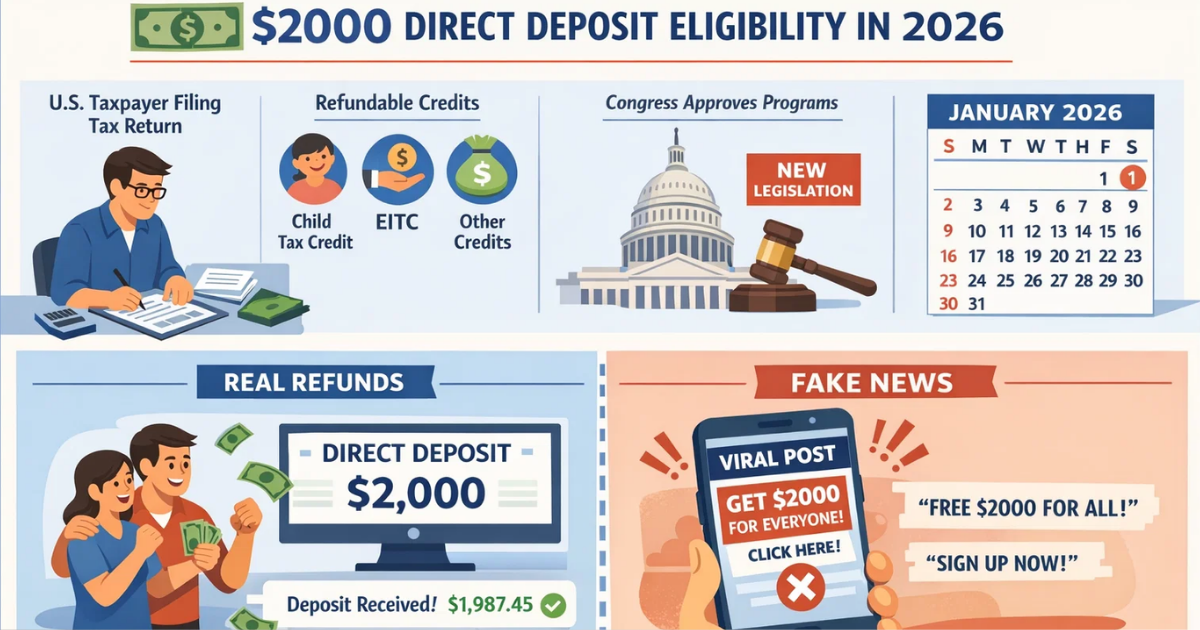
No. As of January 2026, there is no universal IRS $2,000 direct deposit approved for all Americans.
The IRS does not send money automatically unless one of these conditions applies:
- You filed a tax return
- You qualified for refundable tax credits
- Congress passed a specific payment program into law
That means IRS payment eligibility is always tied to tax filings or legislated programs, not viral announcements. Some taxpayers will receive deposits close to $2,000 in 2026, but those payments are tax refunds, not stimulus or relief payments. This is where confusion begins.
Eligibility for any deposit of $2,000 or more depends on your filed returns and IRS $2000 direct deposit eligibility. Refunds may include IRS refundable tax credits 2026, such as EITC and ACTC, which are processed according to the IRS refund schedule 2026. Remember, these are tax refunds, not new stimulus payments.
IRS $2000 Relief: Direct Deposit vs. Paper Check – What to Expect?
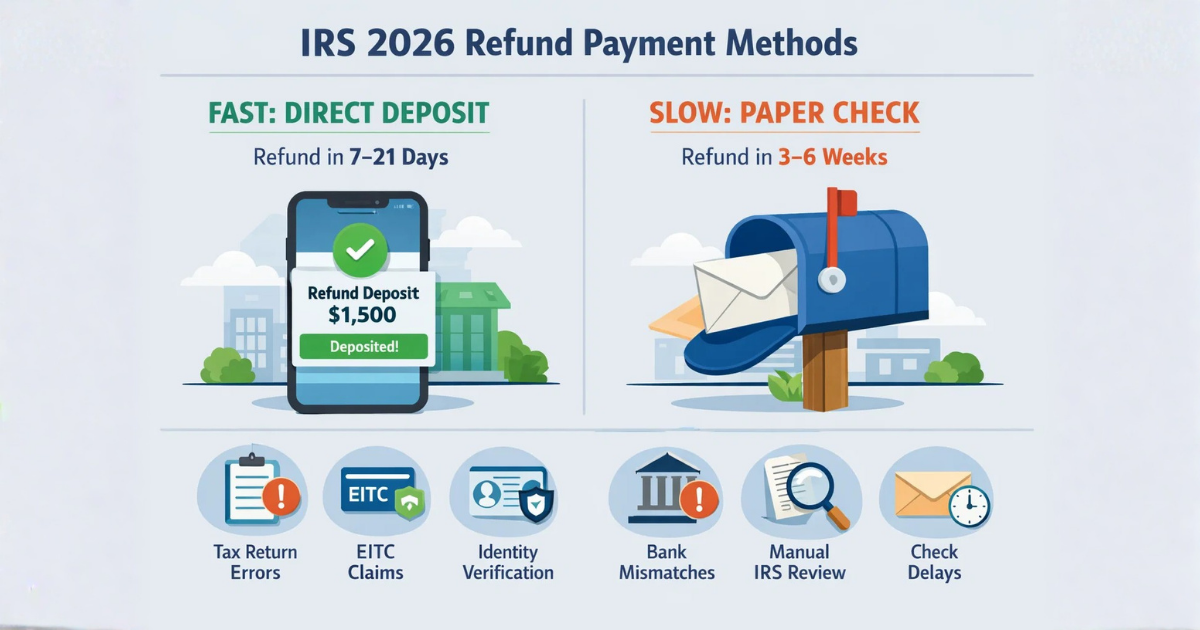
When the IRS issues any legitimate payment, it uses one of two methods:
Direct Deposit
- Fastest option
- Typically arrives 7–21 days after return acceptance
- Used for most refunds and credits
- Follows the official IRS direct deposit schedule
Paper Check
- Slower delivery (3–6 weeks)
- Used if no bank info is on file
- Higher risk of mail delays
If a new program were approved, the IRS would announce the delivery method clearly on IRS.gov. There has been no such announcement for a $2,000 payment. For faster access, most taxpayers use IRS tax refund direct deposit, which follows the official IRS 2026 direct deposit schedule. Paper checks take longer and can be delayed due to mailing issues, so direct deposit timing is generally more reliable.
IRS $2000 Direct Deposit Delayed? Common Issues & Fixes in 2026
Many people checking on the IRS’s $2000 direct deposit timing are actually experiencing delayed refunds. Common causes include:
- Errors on tax returns
- Identity verification requests
- Claiming credits like EITC
- Bank account mismatches
- Manual IRS review
If your refund includes refundable credits, such as the EITC refund timing often delays deposits until late February or March. This can lead to rumors, especially when others see their payments arrive earlier.
Fixes include:
- Checking IRS “Where’s My Refund”
- Responding to IRS letters quickly
- Ensuring accurate bank details
- Avoiding amended returns unless required
Other factors influencing IRS direct deposit timing include pending identity verification, claiming credits such as EITC, and errors in bank processing. Use the IRS refund tracker 2026 and the official “Where’s My Refund” tool to check your status and avoid unnecessary delays.
IRS $2000 Direct Deposit: 2026 Edition
Before diving deeper, here’s a quick reality check:
- Is this a stimulus or a tax refund? For most people, it’s a refund, not a stimulus.
- Has Congress approved the $2,000 payment? No.
- Is there a confirmed deposit date? No universal date exists.
Let’s clarify the confusion by understanding the IRS refund schedule 2026 to help taxpayers plan deposits. Refund timing varies by filing status, claimed credits, or IRS delays for adjustments or prior-year corrections.
Official IRS Policy: No Universal $2000 Payment Scheduled
The IRS has remained consistent and clear.
As of January 2026:
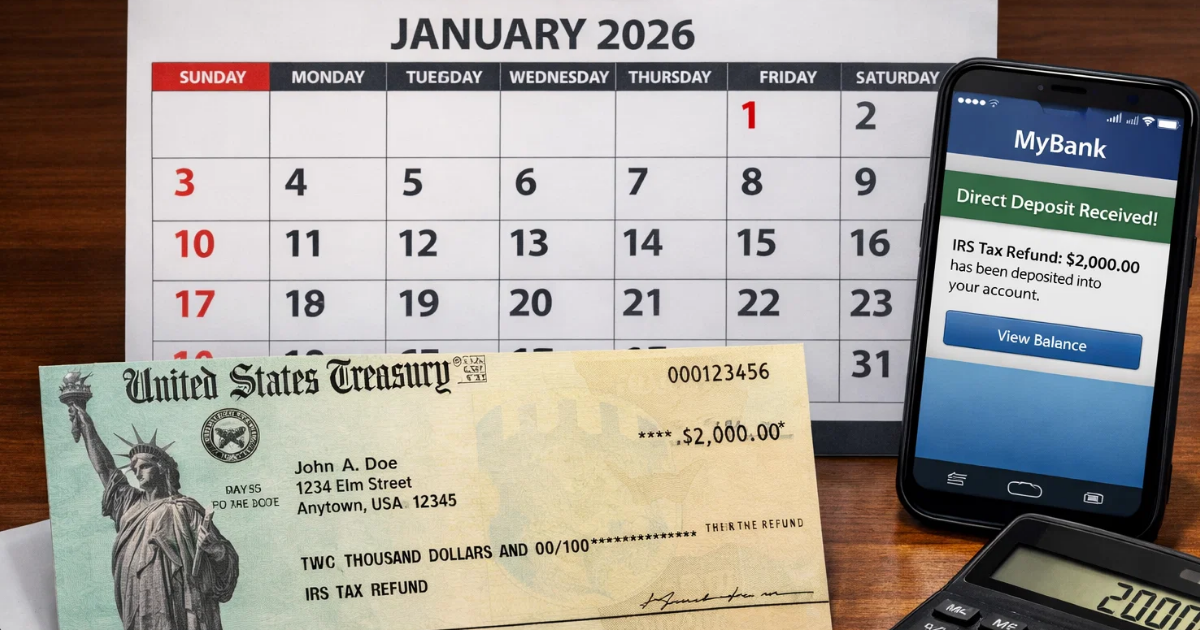
- There is no authorized $2,000 IRS stimulus payment.
- No IRS announcement confirming a $2,000 deposit.
- There is no payment schedule for a universal rebate
The IRS only issues payments tied to:
- Submitted tax returns
- Refundable credits
- Programs passed by Congress and officially enacted into law
Any website that states, “IRS confirms $2,000 payment,” is misrepresenting IRS policy. According to Yahoo Finance, many so-called “$2,000 payments” are actually regular tax refunds that arrive on standard IRS schedules. The IRS only makes payments based on filed returns, refundable credits, or programs approved by Congress. Reports about a universal $2,000 payment are misleading.
IRS Refund Timeline: Estimated 2026 Direct Deposit Schedule
Many taxpayers wonder when their refunds will arrive. There is no universal $2,000 payment, but standard refunds and credits follow the IRS’s schedule. Here’s the 2026 IRS refund timeline for direct deposit based on e-file dates.
| If the IRS Accepts an E-Filed Return By | Direct Deposit Refund May Be Received |
| Jan. 26, 2026 | Feb. 6, 2026 |
| Feb. 2, 2026 | Feb. 13, 2026 |
| Feb. 9, 2026 | Feb. 20, 2026 |
| Feb. 16, 2026 | Feb. 27, 2026 |
| Feb. 23, 2026 | Mar. 6, 2026 |
| Mar. 2, 2026 | Mar. 13, 2026 |
| Mar. 9, 2026 | Mar. 20, 2026 |
| Mar. 16, 2026 | Mar. 27, 2026 |
| Mar. 23, 2026 | Apr. 3, 2026 |
| Mar. 30, 2026 | Apr. 10, 2026 |
| Apr. 6, 2026 | Apr. 17, 2026 |
| Apr. 13, 2026 | Apr. 24, 2026 |
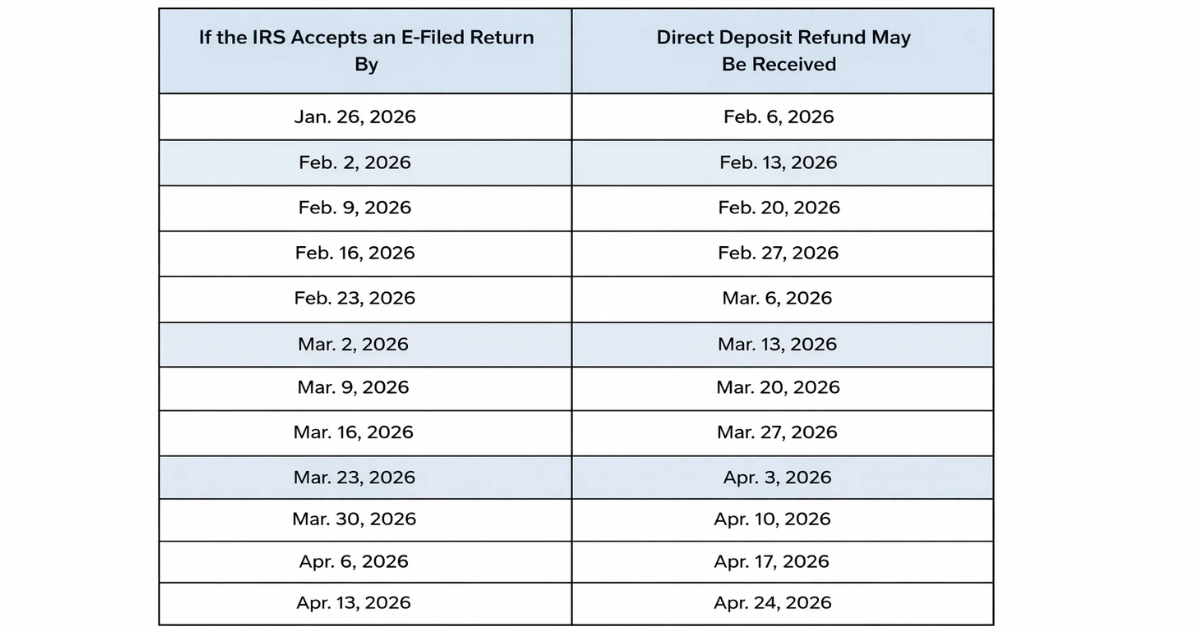
Returns with EITC or Child Tax Credit (CTC) may have delayed deposits until March to allow IRS credit verification. Filing late in peak season (late March–April 15) may also extend processing times.
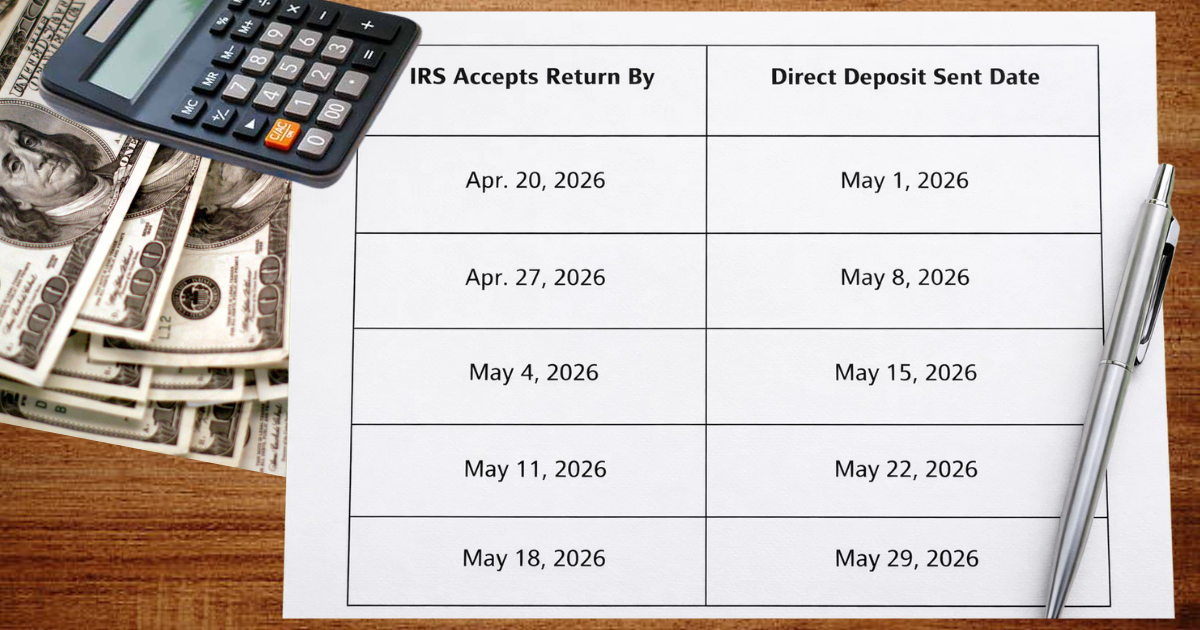
After the April 15 Filing Deadline:
| IRS Accepts Return By | Direct Deposit Sent Date |
| Apr. 20, 2026 | May 1, 2026 |
| Apr. 27, 2026 | May 8, 2026 |
| May 4, 2026 | May 15, 2026 |
| May 11, 2026 | May 22, 2026 |
| May 18, 2026 | May 29, 2026 |
Additional Notes:
- The IRS no longer issues paper checks for tax refunds.
- Use official tools like IRS “Where’s My Refund?” or the IRS2Go app to track IRS direct deposit status.
- Filing early ensures faster processing — gather W-2s, 1099s, mortgage and student loan interest documents before e-filing.
Source: CPA Practice Advisor – Estimated 2026 IRS Tax Refund Dates
Proposed Tariff Rebate / Tariff Dividend Explained
So where did the idea come from?
In 2024 and 2025, several lawmakers floated a tariff dividend proposal, sometimes described as a tariff rebate check. The idea was to return some tariff revenue to Americans.
Why it gained attention:
- Growing worries about inflation
- Media coverage includes CNN, CNBC, and Yahoo Finance.
- Headlines suggesting potential household payments
Important facts:
- The proposal was never accepted.
- No bill was signed into law.
- No agency had permission to send money.
- There is currently no payment date.
Despite headlines, the tariff rebate 2025 checks never materialized. Additionally, a federal rebate payment 2025 linked to tariffs in 2025 also did not happen. Even if a proposal gains attention, only Congress can approve payments. No law has authorized a universal tariff dividend. Taxpayers should rely on IRS direct deposit status tools rather than social media for updates.

Regular IRS Refunds & Tax Credits
Here’s the key misunderstanding:
Many Americans receive refunds of around $2,000 every year.
This comes from:
- Overpaid withholding
- Child Tax Credit
- Earned Income Tax Credit
- Educational credits
According to the IRS refund schedule 2026, most refunds are issued during:
- Late January through early February (simple returns)
- From mid-February to March, claims for EITC and ACTC were filed.
The typical IRS refund schedule is unrelated to stimulus checks, but social media frequently blurs the line. Many $2,000 deposits are the result of routine tax refunds, overpaid withholding, refundable credits such as the EITC, refund timing, or ACTC direct deposit. These adhere to the IRS refund schedule for 2026 and reflect standard tax processing procedures.
Scam Alerts: Be Careful What You Click
Scammers rely on causing confusion. Some warning signs to watch for include
- The IRS confirms a $2,000 payment will be issued today.
- Requests for banking information
- Phony IRS texts or emails
- Countdown timers indicating “deposit deadlines”.
The IRS never:
- Sends payment confirmations through social media channels.
- Requests for personal information via text message.
- Announces payments via influencers.
Avoid IRS phishing refund scams and never share personal information via email or social media. Only verify deposits through the IRS refund status or the official IRS ‘Where’s My Refund’ tool. Scammers often exploit the IRS $2000 payment rumor to trick taxpayers. Always verify information directly on IRS.gov.
Real IRS $2000 Direct Deposit Time Scenarios
So when do people actually see $2,000 deposits?
- No. 1 Scenario: Tax Refund
- Filed the return in late January
- Reported credits
- The refund will be received by the bank in February or March.
- No. 2 Scenario: Back Pay or Adjustment
- IRS amended a previous year’s return.
- Payment is issued following review.
- No. 3 Scenario: Misinterpreted Proposal
- People often confuse news articles with legal statutes.
Neither of these scenarios is a novel stimulus. Deposits of around $2,000 are typically made with tax refunds or previous-year adjustments. Checking the IRS direct deposit date 2026 allows taxpayers to track actual payments and avoid social media speculation.
Why Americans Disagree About the $2,000 Payment
This debate seems endless, and here’s why: one group notices actual $2,000 deposits and assumes a new payment is being made. Meanwhile, another group interprets official IRS statements that deny such payments. Both sides are responding based on different sources of information. Refunds are real. Stimulus rumors are not.
Once you understand the difference between a refund, a rebate, and a proposal, the confusion disappears. Understanding the difference between a refund, a rebate, and proposed programs helps clarify why people disagree. Use the official IRS refund tracker 2026 tools to verify deposits, instead of relying on misleading headlines. CNBC reports it has adjusted federal tax brackets for inflation, affecting withholding and refunds, despite false claims online. For a broader context on how IRS-adjusted tax brackets and federal tax changes are shaping refunds and payments in 2026, see the CNBC video coverage of the IRS’s announcement on new 2026 federal tax brackets.
IRS $2000 Direct Deposit Time — Final Answer
When is the IRS $2000 direct deposit time? There is no universal date, because there is no universal payment. In 2026, any $2,000 deposit will depend on each individual’s tax situation, not on a nationwide program.
IRS $2000 Direct Deposit Time Explained Clearly
To close this debate clearly and responsibly:
- The IRS has not scheduled a universal $2,000 payment.
- Lawmakers have not passed any law approving it
- The IRS has not announced any deposit date
- Most $2,000 payments are standard tax refunds
- The tariff dividend proposal never became law
Official IRS channels are the only reliable way to confirm payments. Check the IRS direct deposit status for 2026 to find out when your refund will be delivered to your bank. Sharing screenshots or falling for viral claims about universal $2,000 payments should be done with caution. Avoid spreading misinformation, ignore sensational headlines, and double-check your sources before sharing. FinanceCurves provides IRS updates, payment timelines, and fact-checked financial news.
Frequently Asked Questions
1. Can I get $2,000 without filing taxes?
No. The IRS does not send payments without a filed tax return unless Congress passes a specific program. Any legitimate $2,000 deposit is tied to a refund, credit, or adjustment.
2. Why are some people receiving $2,000 deposits?
Most are receiving regular tax refunds that total around $2,000 due to withholding, refundable credits, or IRS corrections — not a stimulus payment.
3. How do I check if I qualify?
You qualify only if you filed a tax return and are eligible for a refund or credit. Check eligibility using the IRS “Where’s My Refund” tool on IRS.gov.
4. How do I track my IRS payment or refund?
Use the official IRS “Where’s My Refund” or IRS Online Account. Avoid third-party sites claiming to show early payment dates.
5. Is the $2,000 tariff rebate real or fake?
It was a proposal, not a law. No tariff rebate or dividend payment has been approved or scheduled by Congress or the IRS.
Disclaimer
The information provided on this website is for informational and educational purposes only. While we strive to ensure accuracy and keep our content up to date, FinanceCurves makes no guarantees regarding the completeness, reliability, or accuracy of any information published.
Nothing on this site constitutes financial, tax, legal, or investment advice. Readers should consult a qualified financial advisor, certified tax professional, or licensed attorney before making any financial decisions. Your individual situation may vary, and decisions based on information from this website are made at your own risk.
FinanceCurves may reference government agencies, financial institutions, or official programs for informational purposes only. We are not affiliated with, endorsed by, or connected to any government entity, including the IRS or any federal or state agency. Some content may contain links to third-party websites for additional context or resources. We are not responsible for the content, accuracy, or practices of any external sites.
By using this website, you agree to this disclaimer and our terms of use.

Marshall Mason, Senior Market Analyst at FinanceCurves.com, has over 9 years of experience covering financial markets, cryptocurrencies, and macroeconomic trends. He delivers data-driven insights, independent analysis, and actionable guidance for investors and traders. Marshall leverages authoritative sources, market data, and regulatory updates to help readers navigate volatility, adoption trends, and the evolving landscape of global finance and digital assets.